Why Music Scenes Need More Than a Sound
Why music scenes need more than a sound: see how recurring places, relationships, and shared habits create belonging and help you find a real point of entry.
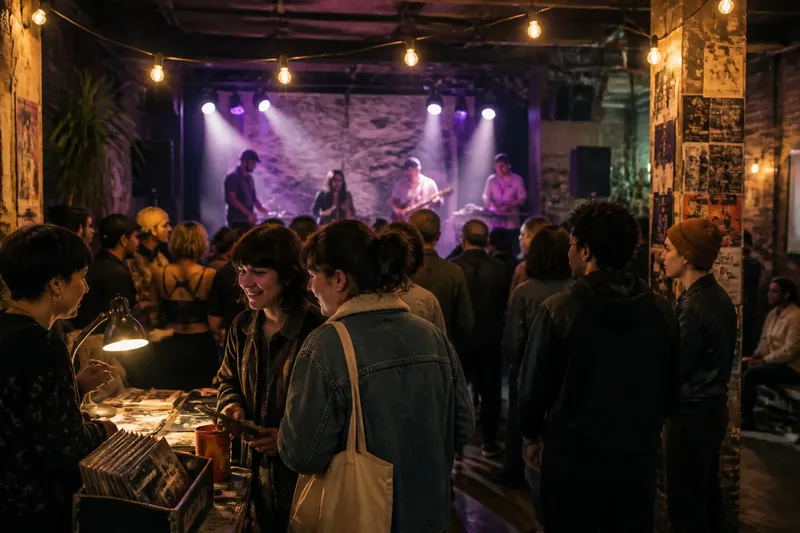
A music scene can bring a synth duo, a noisy guitar band, and a choir night into the same orbit when people keep meeting and making room for one another. Why music scenes need more than a sound becomes clear at the door of a small venue: familiar faces share the set time, help a visiting act find the room, and welcome someone who has come alone.
Sound draws people together and gives them something to discuss. A scene becomes more than a temporary cluster of similar records when its places, relationships, and habits make another meeting possible. You might be looking for new music, hoping to sustain a community, or wondering whether a loose network is open to newcomers.
Scenes grow through repeated connections
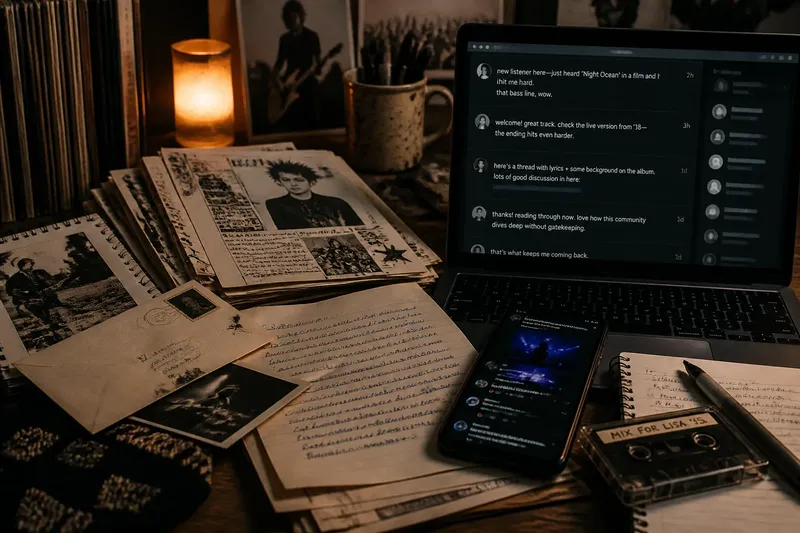
“Scene” can describe artists who exchange ideas, listeners who return to the same events, workers who make those events possible, and local institutions that connect them. One person may belong through playing shows; another through hosting a community radio program, photographing performances, or showing up to listen.
These roles do not carry equal influence, and sharing a neighborhood does not by itself make people a scene. The useful question is whether repeated contact creates pathways between them: a show leads to a collaboration, a venue introduces an artist to a sound engineer, or a listener brings a friend who later helps organize an event.
If you are deciding whether a scene is the right frame for your interest, start with what you want from it. Looking for unfamiliar music calls for one kind of entry; hoping to build lasting relationships calls for another. Neither requires adopting a uniform taste or presenting yourself as an insider.
Recurring venues can lead you to unfamiliar music
For listeners seeking new artists, recurring places can be more revealing than a genre tag. Look at venues, all-ages spaces, record stores, arts centers, community radio programs, rehearsal-room showcases, and neighborhood festivals that return to local performers. Their calendars can reveal connections between acts that a streaming recommendation might keep apart.
Pay attention to who is booked together, who returns to the same room, and whether an event includes more than one kind of performance. A bill pairing an electronic improviser with a folk singer may say less about a shared sound than about a curator’s wish to bring different audiences into one space. Follow that pairing if you are curious about how artists meet and listeners cross paths.
Say you have heard one local band through a friend and want to find other nearby acts. You check the calendar of the room where they played, notice a spoken-word performer and an experimental quartet on an upcoming bill, and go because the combination interests you. You leave with a new artist to follow and a clearer sense of the kind of gathering that room makes possible.
A short checklist makes a scene easier to read
Use these observations to decide whether an event or network suits your interest. Each item pairs something you can notice with a choice you can make; a promising sign need not mean the whole scene is right for you.
- Observe whether the calendar returns to the same venue or event series; if recurring nights make it easier to meet artists and listeners again, then follow the next date, but if the schedule is hard to find, then ask the venue or organizer where updates are posted.
- Observe who shares bills and whether the acts approach music differently; if the combinations spark your curiosity, then attend for discovery, but if you want a specific sound, then check the performers’ recordings before choosing a show.
- Observe whether returning artists are joined by new names; if both appear, then look for a low-pressure way to hear the newcomers, but if the same small circle dominates, then seek another series before deciding the whole scene is closed.
- Observe whether event details explain set times, access arrangements, and how to ask practical questions; if the information is clear, then use it to plan your visit, but if it is missing, then contact the organizer or choose an event with clearer details.
- Observe whether artists, sound workers, and volunteers receive visible credit; if their contributions are named, then you can better understand who sustains the event, but if the labor is obscured, then avoid assuming that every task is fairly shared.
- Observe whether a newcomer can participate through a public event or a clearly described task; if there is an accessible point of entry, then try that option, but if access depends on private introductions, then ask about the process or look for a more open gathering.
- Observe what happens after the performance, such as people sharing future event details or introducing listeners; if useful connections continue, then save the next date or contact, but if you prefer to leave quietly, then take the music you enjoyed without treating networking as an obligation.
Scenes endure through connective work
Artists are visible, but a scene also relies on people who coordinate the conditions around performance. Promoters confirm schedules, sound engineers make a workable stage, venue staff keep the room running, radio hosts circulate music, and volunteers handle details that rarely become part of the public story. If these contributions remain invisible, a small circle can end up carrying too much.
If you organize events, make the connective work legible: share accurate set times, credit collaborators, explain expectations in advance, and offer a clear way for artists or helpers to raise practical concerns. If you attend, arriving for an opening set, buying a record directly from an artist, or respecting the venue’s stated access arrangements can support the people making the gathering possible.
Continuity does not mean keeping a crowded calendar. A scene may benefit from a pause, a conversation after a performance, or a shared resource such as rehearsal space. What matters is whether people can contribute without the structure depending on invisible labor from a narrow circle.
Elaborate planning is not always worth the effort. A color-coded map of every connection or a formal mission statement can consume energy better spent on clear communication and fair credit. Use documents when they solve a real coordination problem, not because a scene needs to look organized from the outside.
Newcomers can participate without proving they belong
Scenes can feel difficult to enter when conversations rely on familiar names, long-running jokes, or local history. You do not have to pretend to recognize everything. Listening closely, asking a straightforward question, and returning when you genuinely want to are more sustainable than performing expertise.
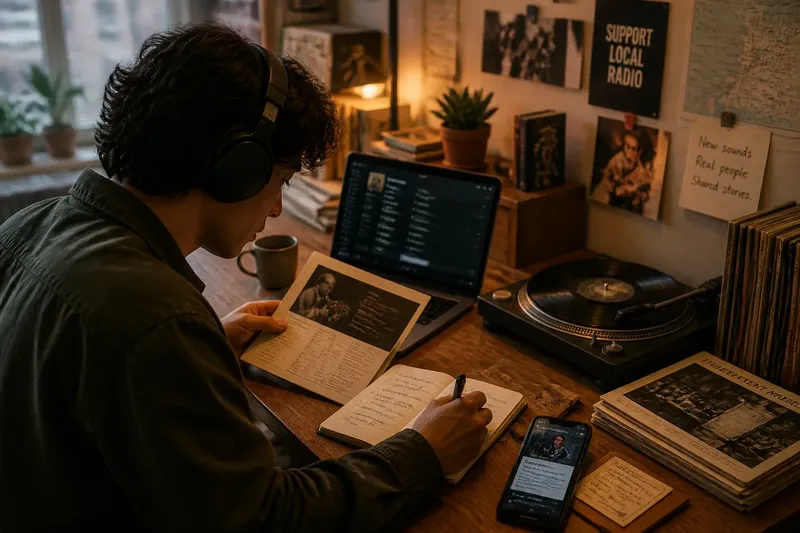
Choose a low-pressure point of contact that suits you. That might be an early set, a community radio show, a clearly bounded volunteer task, or a conversation with an artist after a performance when they are available. Returning to an event can make recognition easier, but every visit need not become networking.
For musicians, the same principle applies. A scene can welcome work unlike its most familiar sound when there is a relationship to the people and spaces around it. Sharing a bill, trading equipment knowledge, or inviting artists with different approaches can create connection without asking anyone to imitate a prevailing style.
You can be interested in a scene and still have boundaries: attend selectively, decline unpaid work that does not suit you, and keep friendships beyond music. Belonging is not a test of constant attendance or agreement with every local opinion.
Open habits matter more than a shared sound
A scene can be musically adventurous and socially narrow. Notice who gets invited back, who appears on promotional materials, who controls access to stages and rehearsal rooms, and whether newcomers can ask basic questions without being mocked. A varied bill does not automatically resolve those patterns.
If you organize or participate, make the route into the room easier to read. Explain how artists can propose a show, describe what a volunteer role involves, and share event information where people outside the organizer’s circle can find it. When conflict arises, address the conduct and its effects rather than treating criticism as a threat to the scene’s identity.
A welcoming reputation means little if new participants have no clear way to enter. The problem may be an unspoken reliance on personal introductions or a habit of assigning every task to familiar friends. Changing one visible routine can give others a fairer chance to take part.
What do people ask about music scenes?
Can artists belong to one scene if they sound different?
Yes. Artists can connect through shared spaces, collaborators, audiences, and recurring events even when their music draws on different traditions. Those links matter when they involve actual exchange, not just a label applied from outside.
Does a music scene need a permanent venue?
No. A scene can gather across rotating rooms, community broadcasts, outdoor events, or informal performance spaces. What matters is whether people can find one another again and carry useful connections between settings.
How can a newcomer take part without seeming intrusive?
Start with a public event or a clearly described task, then follow the expectations organizers have shared. A sincere question about how to attend or contribute is more helpful than assuming private access.
When does a music scene become cliquish?
Entry becomes harder when knowledge, invitations, and opportunities circulate only among a closed circle, especially when no one explains how others can participate. Familiar friendships are not the problem; the problem is when they quietly determine who gets a chance.
Choose a point of entry that fits your interest
If you want to hear something new, follow recurring rooms and the people who put different artists together. If you want to sustain a community, notice the labor that connects its performances and make expectations clearer. If you are entering as a newcomer, choose participation that respects your limits; if access feels restricted, look at the routines shaping invitations and opportunities.
That is why music scenes need more than a sound: musical affinity may bring people within earshot, but repeated encounters give them ways to recognize, support, and challenge one another. A scene can stay musically open when its habits make room for difference and let people return without having to prove they belong.
When deciding where to invest your attention, notice what happens after the performance ends. If people exchange useful information, introduce unfamiliar listeners, credit the work behind the night, or make the next gathering easy to find, you have found a connection that can be carried forward.