From Fan Letters to Online Fan Worlds
Fan letters and online music fandom show how tools reshape participation, while shared attention and thoughtful welcome help listeners find one another.
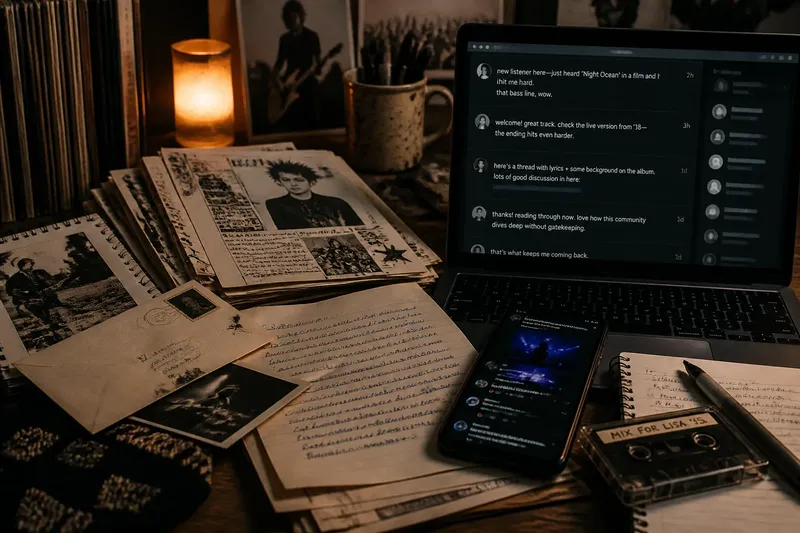
Fan letters and online music fandom share a simple gesture: one listener tells another, “I heard this too.” The routes differ—paper correspondence, fanzines, message boards, group chats—but each can turn private enthusiasm into an exchange. This is a general pattern, not a complete history: formats have overlapped, and fans have used them differently across artists and communities.
Fan letters made attention tangible
A letter took time to compose, address, and send. Fans might write to a musician, a record label, or a magazine, giving private excitement a physical form through handwriting, a copied lyric, or a photograph. Even when no reply came, the writer had made a small artifact of devotion.
Letters traveled through narrow channels. A fan needed an address, a stamp, and some confidence that the recipient would welcome the note. Fan clubs and mail-in columns widened the circle, but participation still depended on someone collecting and distributing correspondence.
The letter’s intimacy remains useful to remember online. A public post can reach many people, yet a personal note may suit a thoughtful thank-you or a reflection on what a song has meant. The medium changes the audience; it does not determine whether the message is sincere.
Fanzines gave listeners a shared editorial space
Fanzines circulated reviews, drawings, concert recollections, interviews, and arguments about bands. Their pages made room for voices that official publicity might not feature. A reader could encounter an interpretation, answer it in a later issue, or pass the zine to a friend.
Print boundaries required editors to choose what belonged. A limited page count shaped the mix of enthusiasm and criticism, while a handmade format could make the community’s labor visible. Readers were not only consuming information; they were seeing how another fan had selected and arranged it.
That editorial role continues in online spaces. A fan-run archive, newsletter, or moderated forum reflects choices about what to preserve and how discussion should feel. The format may be easier to update, but selecting and caring for material remains human work.
Forums made conversation less dependent on publication cycles
Message boards and mailing lists let fans respond to one another without waiting for a printed issue. Discussion could gather around a release, a concert recording, or a question about a lyric, then continue as members returned. Threads made conversation visible as an exchange in progress.
That visibility brought pressures. Regulars could establish shared references and customs, while newcomers might not know how to enter. Searchable archives helped people find older discussions; they could also make a first question feel as though it had already been asked too many times.
Imagine a new listener joining a fan board after hearing a deep album track in a film. Another member links an older thread and adds a friendly note about what has changed since. The expected result is that the newcomer gets useful context and a clear opening to keep talking, rather than facing the archive as a test.
Social platforms made enthusiasm easier to find and harder to hold
Social platforms let fans share clips, images, annotations, and reactions in the same places where they encounter other people’s posts. A detail in a live performance can prompt fresh observations and create a temporary gathering.
But feeds keep moving. A thoughtful discussion can be scattered among jokes, announcements, and unrelated posts, while an older contribution becomes hard to retrieve. Fans may respond with recurring tags, shared documents, private groups, or fan-maintained indexes that give conversation a steadier home.
It is not worth trying to preserve every reaction or turn every exchange into a permanent archive. Some fandom moments are valuable because they are brief: a joke during a livestream or a rush of comments after a song appears. The useful question is which material people will want to find again and who is willing to care for it.
Online music fandom grows through acts of welcome
Online music fandom becomes a community through repeated contact and recognition: people remember names, answer with care, and make room for different levels of knowledge. Members can carry those habits across platforms, even when the conversation has no single home.
What makes online music fandom feel like a community?
Shared references help, but considerate responses matter more than perfect recall of a group’s history. When someone explains an old reference without mocking a newcomer, the conversation has room for both familiarity and discovery.
How can a new fan join without knowing the lore?
Start with a genuine question about a song, performance, or album that caught your attention. A welcoming group offers context without treating fluency in old references as a condition of belonging.
Do fan archives need to preserve everything?
No. An archive can focus on material that is difficult to relocate, such as fan-made translations, concert notes, or useful discussions. Clear descriptions and permission-minded sharing matter more than sheer volume.
How can a group keep discussion open across platforms?
Give recurring conversations a recognizable home, such as a forum thread or shared index, and link to it from faster-moving channels. Avoid assuming everyone uses the same app or sees the same posts.
Fan rituals give people a reason to return
Some practices persist across formats because they give fans something to do together. People trade recommendations, mark an album’s release, annotate lyrics, or revisit a performance on a shared schedule. Tools can alter the scale and pace, while the ritual supplies a reason to return.
Say a small fan group wants to keep discussing a band after a lively chat repeatedly scrolls out of view. They decide to keep the chat for spontaneous reactions, start a recurring listening thread, and create a shared index with links to past discussions. The expected result is that members can still respond in the moment while later readers can find the longer conversation; the tradeoff is that someone must maintain the index, so the group agrees to share that task.
A quiet archive can be more welcoming than a crowded stream, but maintaining it should not become an obligation imposed on one enthusiastic member. Shared responsibility is part of a community’s culture, not merely a technical arrangement.
Care for the record is part of fan expression
Building an online fan world can mean more than posting a reaction. It may mean labeling a concert clip accurately, crediting fan art, asking before reposting someone’s work, or adding context to an old discussion. These choices help enthusiasm travel without erasing the people who made its materials.
Fan letters made attention personal and deliberate; online music fandom can make it collaborative. One person remembers, another organizes, and someone new arrives with a question. As formats change, a useful sign of a welcoming fan world is whether it gives the next listener a considerate place to begin.